
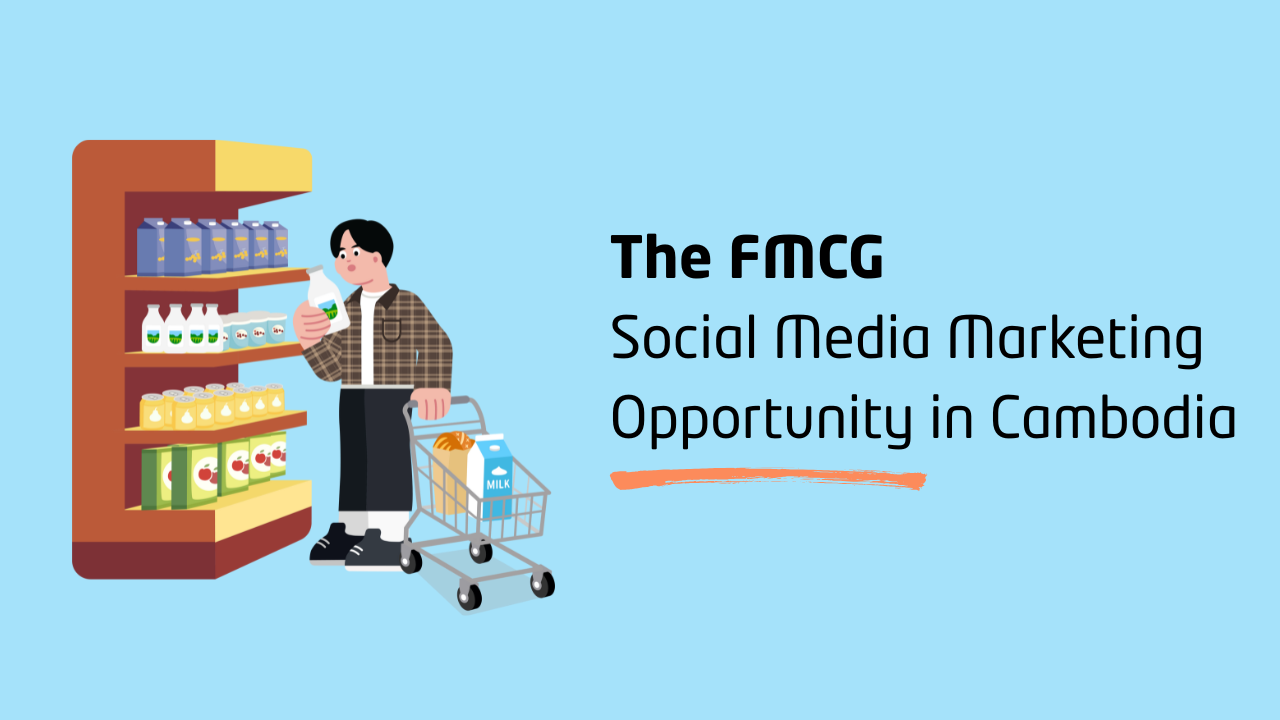
Cambodia’s rapid digital transformation is reshaping how fast-moving consumer goods (FMCG) brands reach customers. With social media deeply embedded in everyday life, platforms such as Facebook and TikTok are no longer optional marketing tools—they are now essential drivers of product discovery, trust, and purchase decisions.
What is FMCG?
Fast-moving consumer goods (FMCG) refer to products that are sold quickly at relatively low cost. These include food and beverages, personal care products, and household essentials such as biscuits, shampoo, milk, detergent, and tissues. Because FMCG products are purchased frequently and have low profit margins per unit, success depends heavily on brand visibility, trust, and consumer familiarity.
The Opportunity: Why Social Media is Critical for FMCG in Cambodia
1. Massive Social Media Adoption is Changing Product Discovery
Cambodia has experienced rapid growth in social media adoption. As of January 2025, Cambodia had 12.9 million social media user identities, equivalent to 72.4% of the total population (DataReportal, 2025). This number continued to grow, reaching approximately 14.0 million users, or 77.9% of the population, by early 2026, highlighting how deeply social media is integrated into Cambodian society (DataReportal, 2026).
TikTok, in particular, has become a dominant platform, with approximately 10.7 million adult users in Cambodia, demonstrating its strong reach and influence in consumer engagement and product discovery (DataReportal, 2025).
This widespread adoption means that the majority of Cambodian consumers can now be reached directly through digital channels.
2. Supermarket Expansion Increases Competition—But Social Media Restores Visibility
Cambodia’s retail sector has modernized rapidly, with supermarkets such as AEON, Lucky, and Chip Mong expanding nationwide. However, modern retail environments limit product visibility due to:
- Limited shelf space
- Strong competition from multinational brands
- High listing and placement fees
In such competitive environments, social media allows FMCG brands to build awareness before consumers enter stores.
Social media plays an increasingly central role in Cambodia’s digital economy. Many internet users primarily navigate through platforms such as Facebook, while social media influencers and digital platforms are emerging as important drivers of commerce and consumer engagement (World Bank, 2023).
3. Trust is Built Online—and Trust Drives Purchase Decisions
Trust is one of the most important drivers of FMCG purchasing decisions. In Cambodia, social media plays a central role in building this trust.
Consumers increasingly rely on:
- Influencer recommendations
- Peer reviews
- User-generated content
- Product demonstrations
These forms of social proof significantly influence purchasing decisions, especially for everyday consumer products.
4. AI-Targeted Advertising Makes Marketing More Efficient
Platforms such as Meta (Facebook and Instagram) and TikTok use artificial intelligence to optimize advertising delivery based on user behavior, engagement, and interests.
These platforms analyze:
- Content interaction
- Engagement behavior
- Viewing patterns
- Purchase intent signals
This allows brands to deliver highly relevant advertisements to consumers, improving efficiency and reducing wasted advertising spend (Meta, 2025; TikTok Business, 2025).
Unlike traditional advertising, which targets broad demographics, AI-driven advertising targets real consumer intent.
This makes social media marketing accessible even for smaller FMCG brands with limited budgets.
5. Social Media Provides Massive Reach at Low Cost
Cambodia’s high social media penetration enables brands to reach large audiences quickly and cost-effectively.
Because over 77% of Cambodians are active on social media, digital platforms offer one of the most scalable marketing channels in the country (DataReportal, 2026).
This allows FMCG brands to:
- Reach nationwide audiences instantly
- Increase brand awareness rapidly
- Compete with larger brands more effectively
Social media significantly lowers the barrier to market entry.
6. Social Media Provides Real-Time Consumer Insights
Beyond marketing, social media serves as a powerful market research tool.
Brands can monitor:
- Customer comments and feedback
- Engagement levels
- Product preferences
- Trending flavors or product formats
This real-time feedback allows brands to adapt quickly to consumer preferences and improve product-market fit.
According to the World Bank (2023), digital platforms are increasingly enabling businesses in Cambodia to improve customer engagement and make data-driven business decisions.
Social media has evolved into more than just a marketing channel—it is now a complete commerce ecosystem. Platforms like TikTok and Facebook allow consumers to discover products, build trust through reviews and creators, and purchase directly through features such as TikTok Shop, Facebook Marketplace, and live selling. This enables FMCG brands to manage marketing, customer relationships, market research, and sales in one place. By shortening the journey from discovery to purchase, social media allows brands to convert attention into sales more efficiently than ever before.
References
- DataReportal. (2025). Digital 2025: Cambodia.
https://datareportal.com/reports/digital-2025-cambodia - DataReportal. (2026). Digital 2026: Cambodia.
https://datareportal.com/reports/digital-2026-cambodia - World Bank. (2023). Cambodia Digital Economy Assessment.
- Meta. (2025). Meta Ads Guide and Optimization Overview.
- TikTok Business. (2025). TikTok Advertising and Algorithm Overview.